AI Implementation
Why Your AI Projects Fail After the Demo Works
AI demos work because they avoid the messy operating conditions that production systems face: workflow context, memory, integration, exceptions, adoption, and support.
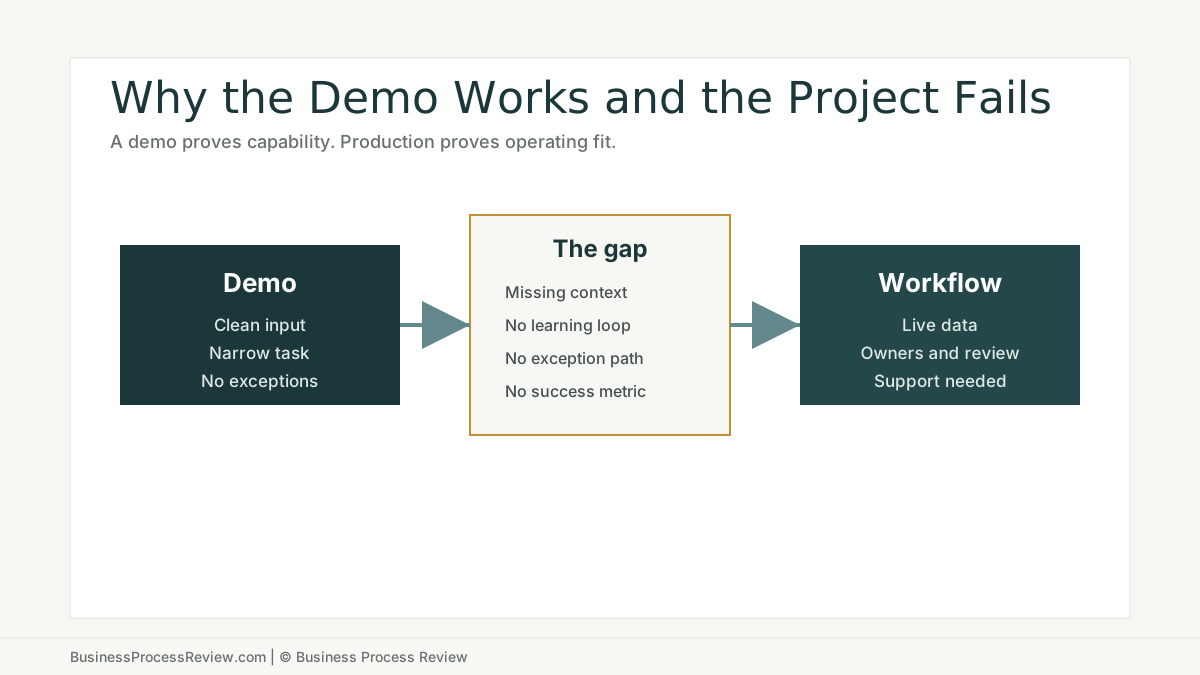
Your AI demo worked because the demo was protected from the business.
It had clean inputs.
It had a narrow task.
It had a patient reviewer.
It did not have missing fields, weird customer requests, old data, informal approvals, manager interruptions, staff workarounds, or a support queue.
That is why many AI projects look useful in a meeting and disappear after launch.
The short answer
AI projects fail after the demo because the demo proves capability, not operating fit.
A production workflow needs:
- real data
- system access
- source-of-truth rules
- workflow ownership
- exception handling
- human review gates
- employee training
- feedback loops
- maintenance
- success metrics
If those are missing, the project becomes another experiment.
Read the MIT NANDA report
The MIT NANDA State of AI in Business 2025 report is useful because it separates adoption from transformation. The report is based on a review of more than 300 publicly disclosed AI initiatives, interviews with representatives from 52 organizations, and survey responses from 153 senior leaders.
Its main point is blunt: many organizations are experimenting with AI, but very few are getting measurable business impact from integrated systems.
That matches what operators see.
People use AI. Projects launch. Demos impress. Workflows still do not change.
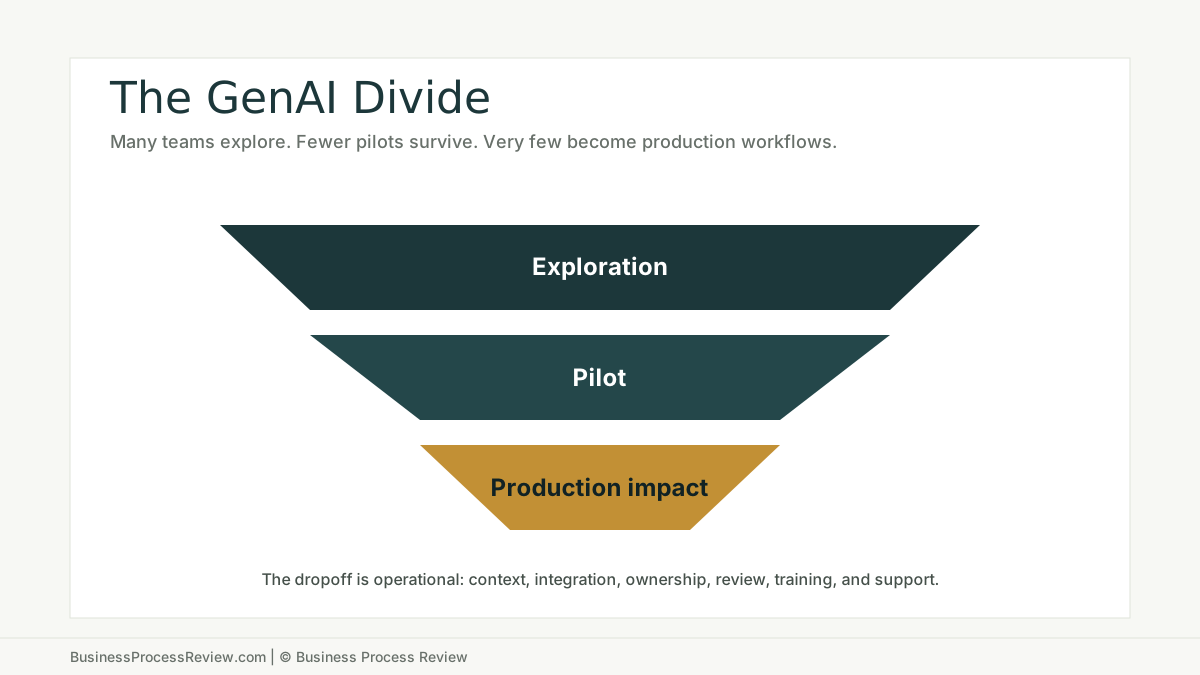
The GenAI divide is really an operations divide
MIT NANDA describes a divide between high AI adoption and low transformation. The report says many organizations have explored or piloted general-purpose tools, while task-specific enterprise AI tools have a steep drop from evaluation to production.
The cause is not only model quality.
The report points to brittle workflows, lack of contextual learning, and poor fit with day-to-day operations.
That is the part most businesses should focus on.
Demos avoid the hard parts
A good demo shows:
- the model can summarize
- the model can classify
- the model can draft
- the model can extract
- the model can answer questions
A real implementation asks:
- Which source data is authoritative?
- What happens when the input is incomplete?
- Who approves the output?
- Which system gets updated?
- What does the employee stop doing?
- What is the exception path?
- Who fixes bad output?
- Who measures the result?
Those questions are not cosmetic. They are the project.
The learning gap
MIT NANDA argues that the core scaling barrier is learning. Many systems do not retain feedback, adapt to context, or improve over time.
For an SMB, this shows up in simple ways.
An AI assistant drafts a response but does not learn the company’s tone.
A document extractor makes the same mistake every week.
A routing workflow does not adapt when a customer type changes.
An internal knowledge bot returns old policy because nobody owns updates.
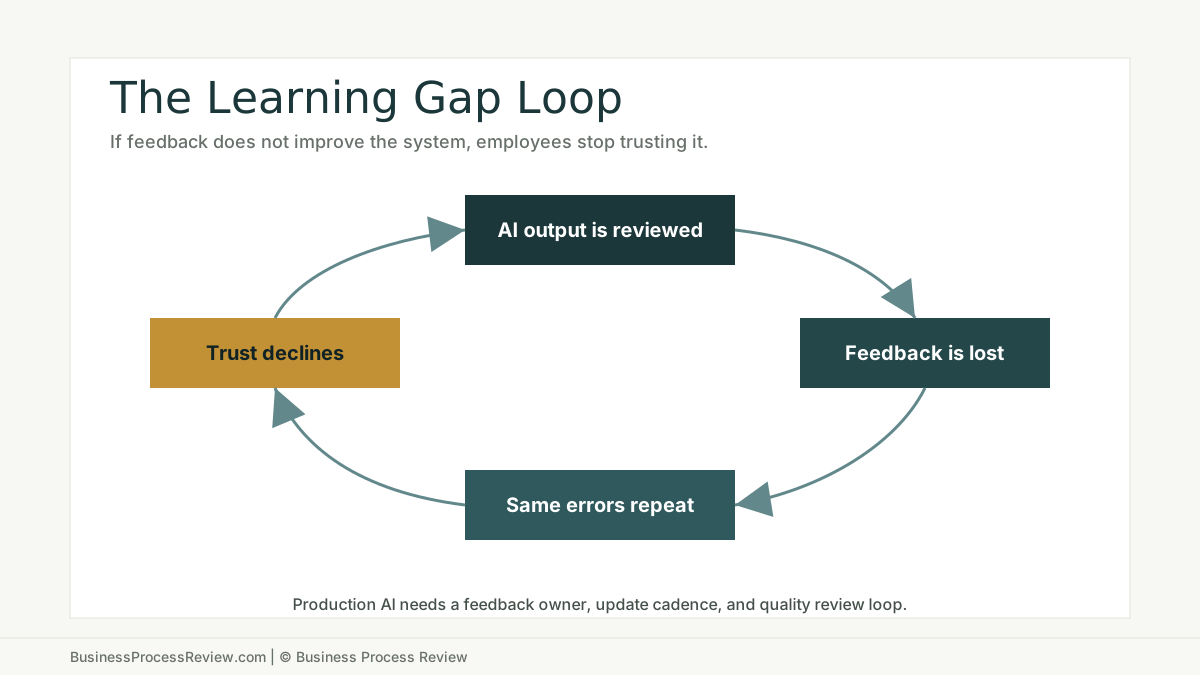
The tool may still function.
The workflow does not improve.
Why official projects lose to informal AI use
The MIT report also describes shadow AI: employees using personal AI tools outside formal channels because those tools are flexible and immediately useful.
That is a warning.
It means employees are finding real use cases faster than official projects in some companies. The official project may be safer, better funded, and better documented. But if it does not fit the daily workflow, employees work around it.
This is not a reason to ignore risk. It is a reason to study behavior.
What are employees already using AI for?
Which tasks keep showing up?
Which outputs do they trust?
Where are they copying sensitive data?
Where could a safer internal workflow replace the informal one?
How to test production readiness
Before scaling, test the project against production conditions.
Ask:
- Can it handle messy inputs?
- Can it identify missing information?
- Does it know the source of truth?
- Can employees review output quickly?
- Are exceptions routed to the right person?
- Does the workflow remove an old step?
- Does it reduce rework or delay?
- Can the company maintain it?
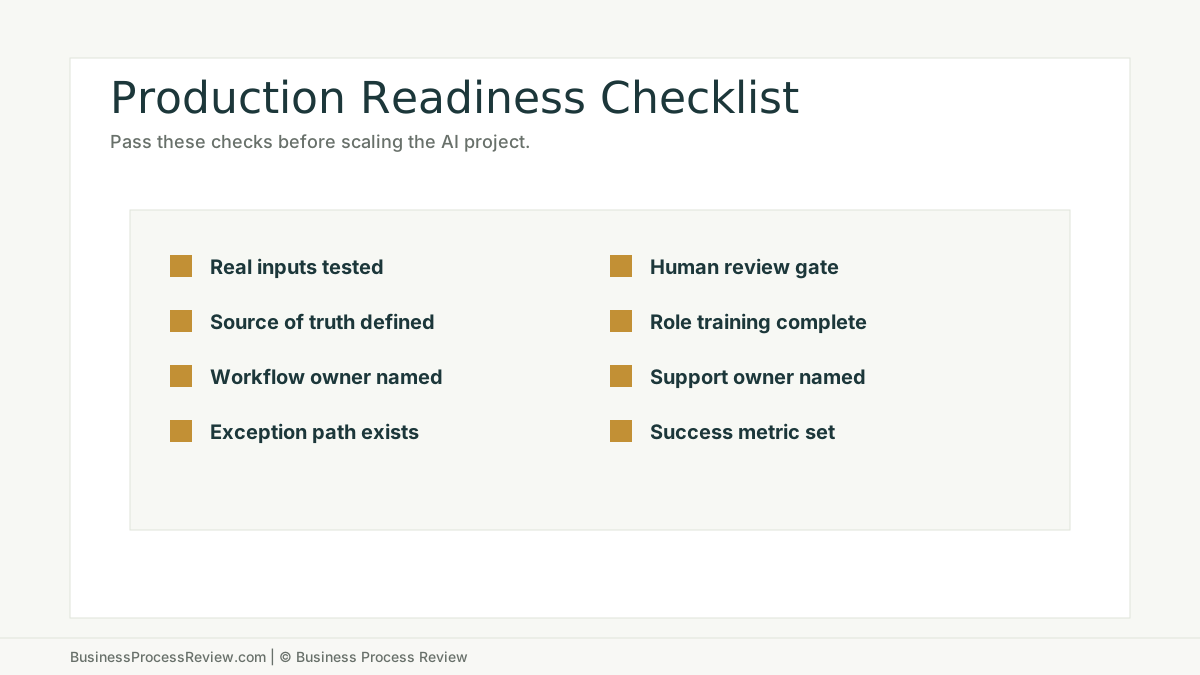
If you cannot answer those questions, you do not have an implementation yet.
You have a demo.
The practical path
Use this sequence:
- Pick one workflow.
- Map the current state.
- Identify the manual work and rework.
- Define the source of truth.
- Choose one AI-supported step.
- Define human review.
- Test real examples.
- Train the roles involved.
- Launch with support.
- Measure the workflow.
This is why a business process review should come before most AI builds. It gives the project operating context before technical work starts.
When to stop the project
Some AI projects should stop.
Stop when:
- the workflow is too unclear
- the data is not trusted
- the use case has low business value
- every case requires special judgment
- employees will not adopt the new path
- the maintenance burden is larger than the benefit
Stopping is not failure. Continuing a bad project is failure.
When to bring in help
Bring in help when the demo works but the implementation path is vague.
Business Process Review can review the workflow, define the operating requirements, scope a narrow AI automation implementation, and support the system after launch.
The goal is not a better demo.
The goal is a workflow that runs better after AI is added.

About the Author
Will Gordon
Will Gordon is the founder of Business Process Review and Chief Technology Officer at Billfy. He works on workflow systems, automation, and partnerships in the ServiceNow ecosystem, with a focus on practical operational improvements for growing businesses.
Connect with Will on LinkedInFAQ
Common Questions
Why do AI projects fail after a successful demo?
They fail because the demo avoids production conditions. Real workflows need reliable data, system integration, ownership, exception handling, human review, training, and support.
Is a working AI demo enough to prove business value?
No. A demo proves technical possibility. Business value requires the system to improve a real workflow and produce measurable operational impact after launch.
What is the AI pilot-to-production gap?
The pilot-to-production gap is the drop between a promising test and a working system that is adopted, integrated, reviewed, maintained, and measured in daily operations.
What should be tested before scaling an AI project?
Test real inputs, edge cases, review rules, source-of-truth quality, employee behavior, support needs, and the metric that proves the workflow improved.
How can a business avoid AI project failure?
Start with one workflow, define the current state, select a narrow use case, build around real operating constraints, and measure outcomes after launch.