AI Implementation
Why Most AI Implementations Fail Inside Small Businesses
AI implementations usually fail inside small businesses because the workflow is unclear, the data is weak, ownership is missing, and the pilot never becomes an operating system.
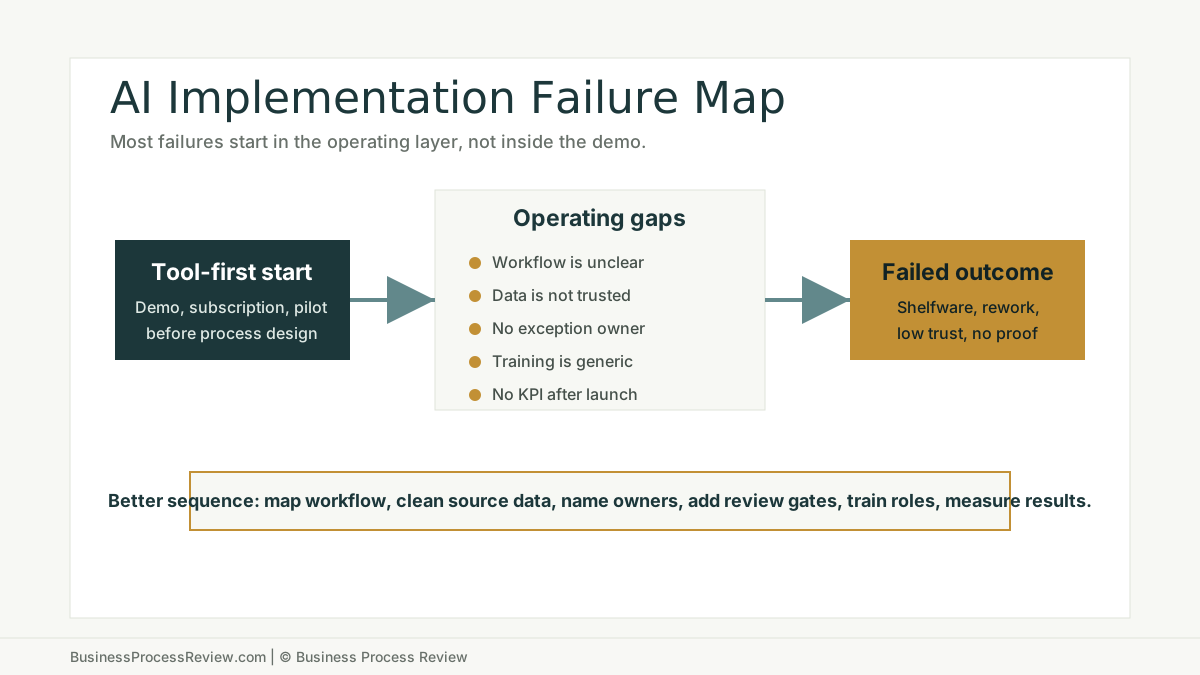
AI implementations rarely fail because the demo was bad.
They fail because the demo was never the business.
The demo had clean data, a narrow scenario, a patient user, and no real exception path. The business has partial records, busy employees, unclear ownership, customer pressure, old workarounds, and managers asking whether the thing saved time.
That gap is where AI projects stall.
The short answer
AI implementations fail inside small businesses when the company treats AI as a tool purchase instead of an operating change.
The common failure points are:
- unclear workflow
- unreliable data
- no source of truth
- weak ownership
- no review gate
- generic employee training
- no pilot-to-production plan
- no maintenance owner
- no measurement after launch
If those are not handled, AI becomes another system sitting beside the real work.
Adoption is high. Operational impact is uneven.
AI use is no longer rare.
McKinsey’s 2025 State of AI research says nearly nine out of ten survey respondents report regular AI use, but only about 6 percent meet McKinsey’s high-performer definition. The gap matters. Using AI and getting durable business value from AI are different things.
McKinsey also reports that AI high performers are more likely to redesign workflows, scale faster, and use management practices across strategy, talent, operating model, technology, data, adoption, and scaling. That is the part many small businesses skip.
They buy a tool. They do not redesign the work around it.
Failure 1: The workflow is not defined
AI cannot reliably improve a workflow the company cannot explain.
Ask five people how a request moves from intake to completion. If you get five versions, the business is not ready for AI implementation. It is ready for mapping.
This shows up in small ways:
- requests arrive through email, forms, chat, and text
- required fields are missing
- approvals happen outside the system
- status lives in a spreadsheet
- exceptions go to whoever is available
- the final decision is not recorded in one place
The AI tool may still produce output. That does not mean the workflow improved.
It may only make the unclear process move faster.
Failure 2: The data is not trustworthy
AI depends on the quality of the information it receives.
This is not only a technical issue. It is an operating issue.
If two systems disagree, if records are incomplete, if documents are not current, or if employees do not trust the source data, the AI system inherits the same confusion.
PwC’s responsible AI and data governance guidance frames complete, high-quality, trustworthy data as foundational to AI initiatives. Dun & Bradstreet’s 2026 AI Momentum Survey release reported that only 5 percent of surveyed organizations said their data was fully ready for AI. Treat that as company research, not a universal benchmark, but the operating point is sound: data readiness is a bottleneck.
For SMBs, weak data often looks ordinary:
- duplicate customer records
- old job titles
- stale documents
- missing close dates
- inconsistent candidate notes
- invoice records that do not match project records
- files saved under different names
AI does not make that cleaner by itself.
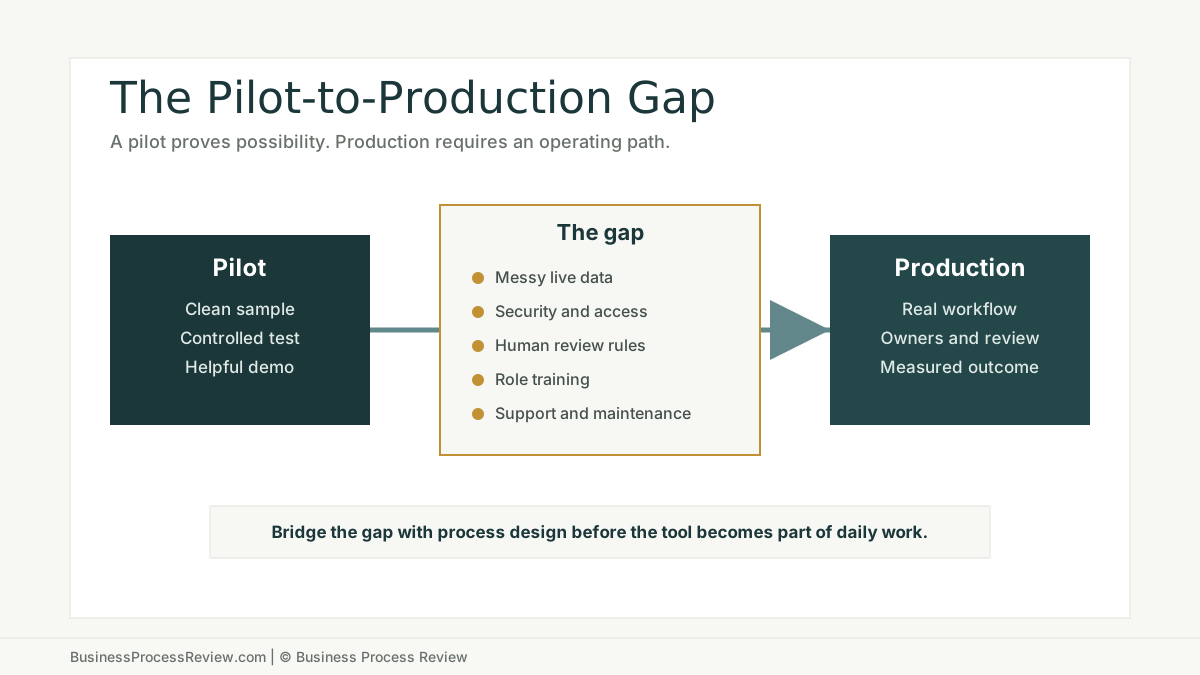
Failure 3: The pilot has no path to production
Many AI pilots are designed to impress, not to operate.
The pilot answers:
- Can the tool summarize this?
- Can it classify that?
- Can it draft a response?
- Can it extract fields from a document?
Production answers different questions:
- Who owns the workflow?
- What data can the system access?
- What happens when it is wrong?
- Who reviews exceptions?
- What metric proves improvement?
- Who maintains prompts, rules, integrations, and access?
- What old step gets removed?
McKinsey’s article on gen AI programs identifies failure to innovate and failure to scale as common hurdles, with process constraints, rework, risk concerns, and cost overruns contributing to delays. In a small business, the same pattern appears in simpler form: the test works, but nobody turns it into the new way work moves.
Failure 4: No one owns review and exceptions
AI implementation needs named ownership.
Not vague ownership. Named ownership.
A working implementation should define:
- business owner
- workflow owner
- technical owner
- human reviewer
- exception owner
- training owner
- measurement owner
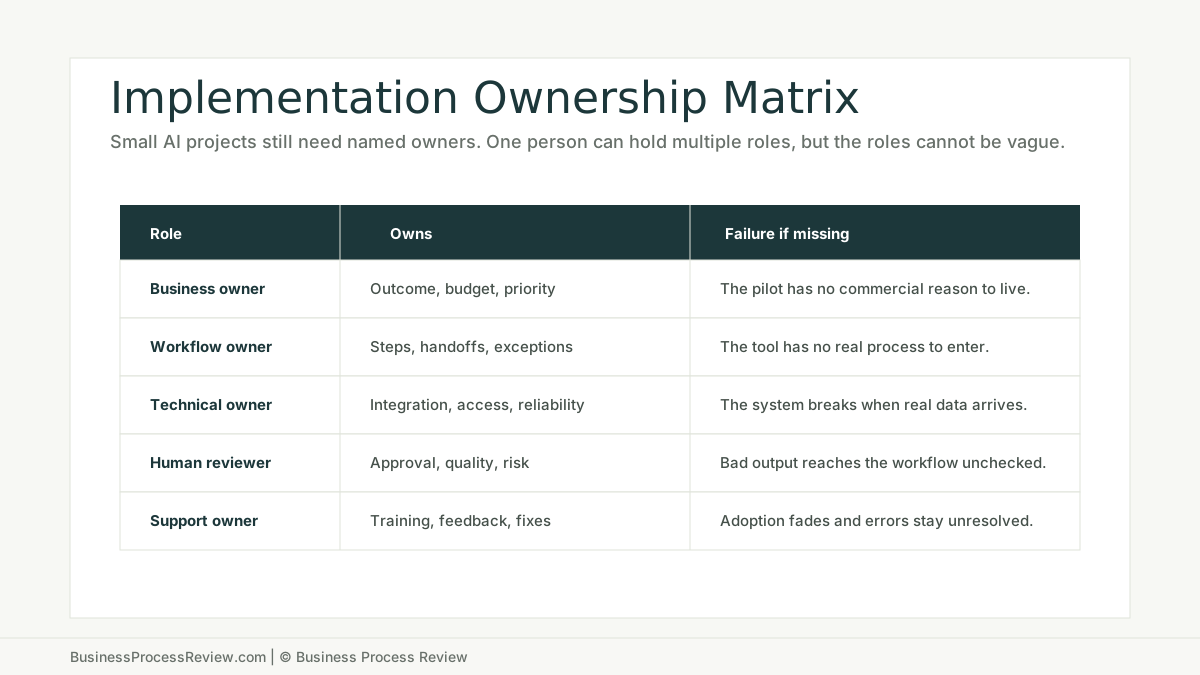
This is where small businesses often struggle. The same person may wear several hats. That is fine. What is not fine is leaving the roles unnamed.
If AI drafts a quote, who approves it?
If AI routes a customer request incorrectly, who catches it?
If the output quality drops, who fixes the workflow?
If the team stops using it, who notices?
Failure 5: Training is generic
Generic AI training creates generic behavior.
Employees do not need a broad tour of every AI tool. They need role-specific guidance:
- what AI is allowed to do
- what AI is not allowed to do
- what data cannot be entered
- when output must be reviewed
- which workflow changed
- what old workaround should stop
- how to report a bad output
This is why employee AI training should be tied to real workflows. Training should not end with “here are prompts.” It should end with “here is how this role now performs this part of the process.”
Failure 6: Risk is handled after the fact
Risk cannot be taped onto an AI workflow after launch.
NIST’s AI Risk Management Framework is voluntary and use-case agnostic, but its practical implication is simple: risk management needs to be part of design, deployment, and use.
For small businesses, this means deciding:
- what data the system can access
- where human review is required
- what errors matter most
- how outputs are logged
- who can change prompts or rules
- what customer-facing claims are allowed
- what happens when confidence is low
KPMG’s Q1 2026 AI Pulse reports that scaling AI use cases, workforce skills gaps, and risk management are major execution issues for organizations moving AI into operations. SMBs should take the warning seriously. A small system can still create real risk if it touches customers, money, hiring, compliance, or sensitive data.
Failure 7: Nothing is measured after launch
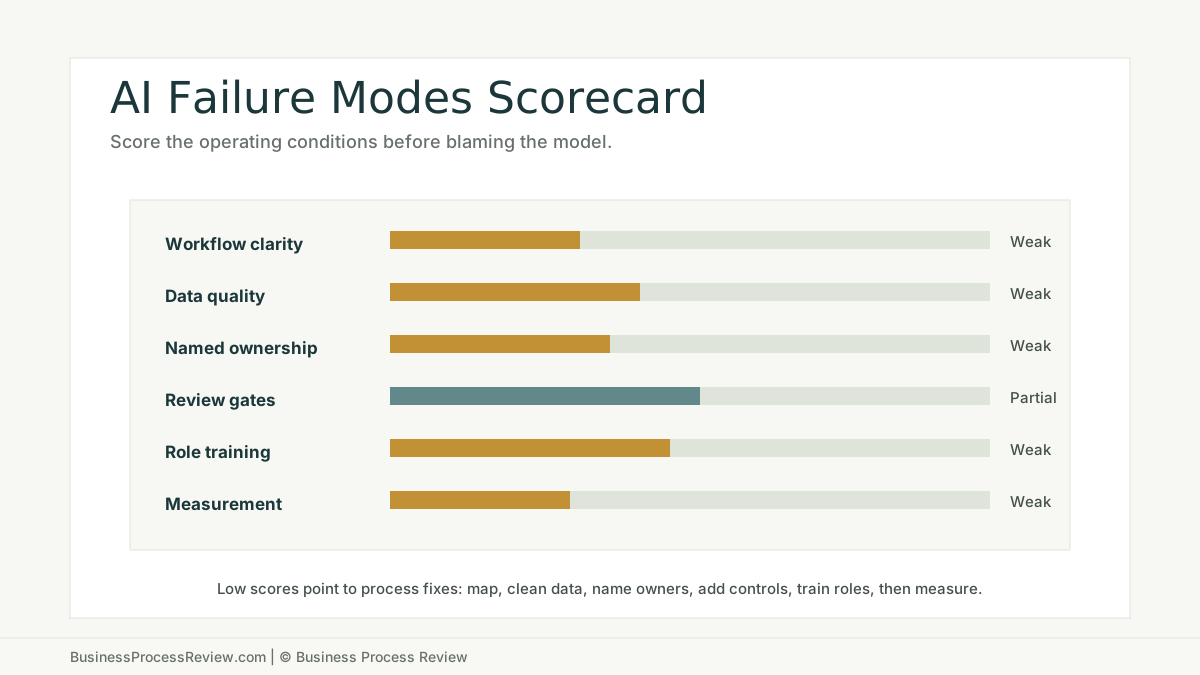
If the business cannot measure the old workflow, it cannot prove the new one is better.
Useful metrics include:
- cycle time
- touch count
- rework rate
- review time
- error rate
- response time
- staff adoption
- customer delay
- manager follow-up time
Do not measure only usage. A tool can be used often and still fail to improve the operation.
Measure the workflow.
What a practical implementation should include
A practical AI implementation starts narrower than most owners expect.
Pick one workflow. Choose one repeated step. Define the current state before building.
The sequence should look like this:
- Map the workflow.
- Identify the manual work and failure points.
- Define the source of truth.
- Decide what AI can do and what humans must review.
- Build a small working version.
- Test with real examples, including exceptions.
- Train the roles involved.
- Launch with a support window.
- Measure the result.
- Improve or stop.
That last word matters.
Some AI projects should be stopped. If the workflow is too messy, the data is too weak, the team will not adopt it, or the cost is not justified, stopping is a good decision.
When the implementation is worth it
AI implementation is worth exploring when the workflow has:
- repeated volume
- clear business value
- stable inputs
- defined owner
- reviewable output
- trustworthy data
- measurable improvement potential
Good SMB use cases are usually boring:
- intake checks
- document classification
- first-pass summaries
- internal search
- customer response drafts
- routing
- reminders
- status updates
- report preparation
The boring work is where the value lives because the work repeats.
When to bring in help
Bring in help before the company has already bought three tools and lost internal trust.
Business Process Review can scope AI automation implementation around one real workflow, connect it to a process review, create role-specific training, and provide ongoing optimization and support after launch.
The goal is not to make the company look advanced.
The goal is to make the work run better.

About the Author
Will Gordon
Will Gordon is the founder of Business Process Review and Chief Technology Officer at Billfy. He works on workflow systems, automation, and partnerships in the ServiceNow ecosystem, with a focus on practical operational improvements for growing businesses.
Connect with Will on LinkedInFAQ
Common Questions
Why do AI implementations fail in small businesses?
They usually fail because the business starts with a tool before defining the workflow, source data, owner, review process, training plan, and success metric.
Is AI implementation failure usually a technology problem?
Sometimes, but not usually. In small businesses, the larger problem is often workflow ambiguity, poor data quality, weak adoption, unclear accountability, or no path from pilot to production.
What is the biggest warning sign before an AI implementation?
The biggest warning sign is disagreement about how the current workflow works. If the team cannot map the process, AI will not have a stable operating path.
How can a small business reduce AI implementation risk?
Start with one workflow, document the current state, define owners and review gates, test with real data, train the people involved, and measure outcomes after launch.
When should a business get help with AI implementation?
Get help when the AI system will touch customer work, sensitive data, staff workflows, approvals, reporting, or any process where errors create operational risk.